A very long time in the past, on an island referred to as England, a classically educated and extremely revered actor lamented to his agent a couple of job that had been proposed by an up-and-coming director. The actor learn the upstart director’s script and regarded it “clunky fairy story garbage” with an absurd premise. He admitted to buddies that he had little curiosity in being related to what seemed like a foolish B-movie. Sadly, as is so usually the case, classically educated actors typically discover themselves within the place of taking a job they do not imagine in just because the pay is simply too good to disregard.
The yr was 1976. The director was George Lucas. The film was “Star Wars.” And the reluctant actor was Sir Alec Guinness.
On the time, Guinness was already a legend. He had an Oscar for “The Bridge on the River Kwai,” had starred in additional than fifty movies, and was considered one in every of Britain’s best Shakespearean performers. But right here he was, thumbing by way of a script about laser swords, area smugglers, and a villain in a black masks named Darth Vader. To Guinness, it seemed beneath him. To Lucas, Guinness was the one performer who may lend gravitas to his story. To entice Guinness to the function, Lucas and the movie studio behind the challenge supplied Alex a wage of $150,000. After adjusting for inflation, that is the identical as round $850,000 in at this time’s {dollars}. A powerful payday made much more spectacular when you think about that Alec would have simply 20 minutes of display time within the movie, which absolutely nobody would ever even see. Nonetheless, that wasn’t sufficient. So Alec’s agent went again to Lucas and the studio with one other request…
These Are The Factors You are Wanting For
Alec Guinness was no extraordinary supporting actor, and his agent knew it. The $150,000 paycheck may need been beneficiant for just a few weeks of labor, however Guinness wished greater than only a flat payment. He wished possession. So his workforce got here again to George Lucas and twentieth Century Fox with a daring request: backend factors.
In Hollywood, “factors” refers to a share of a movie’s gross income. On the time, this type of association was uncommon for an actor in Guinness’s place — particularly in what seemed like a low-budget area journey from a comparatively untested director. However Guinness’s status gave him leverage, and Fox was determined to have a performer of his stature connected to the challenge. The studio agreed. Guinness would obtain 2% of the movie’s field workplace gross, and Lucas personally sweetened the deal by including an additional 0.25% out of his personal share.
To most observers in 1976, this appeared like a meaningless concession. “Star Wars” wasn’t anticipated to do a lot enterprise past a modest run. Even Guinness himself assumed the movie could be a curiosity at finest, one thing which may earn him just a few additional kilos if audiences confirmed up. In his diary, he joked that he was taking the job as a lot out of resignation as pleasure.
What Guinness couldn’t have recognized was that this single negotiation — insisting on factors — would turn out to be one of many smartest monetary strikes in film historical past.
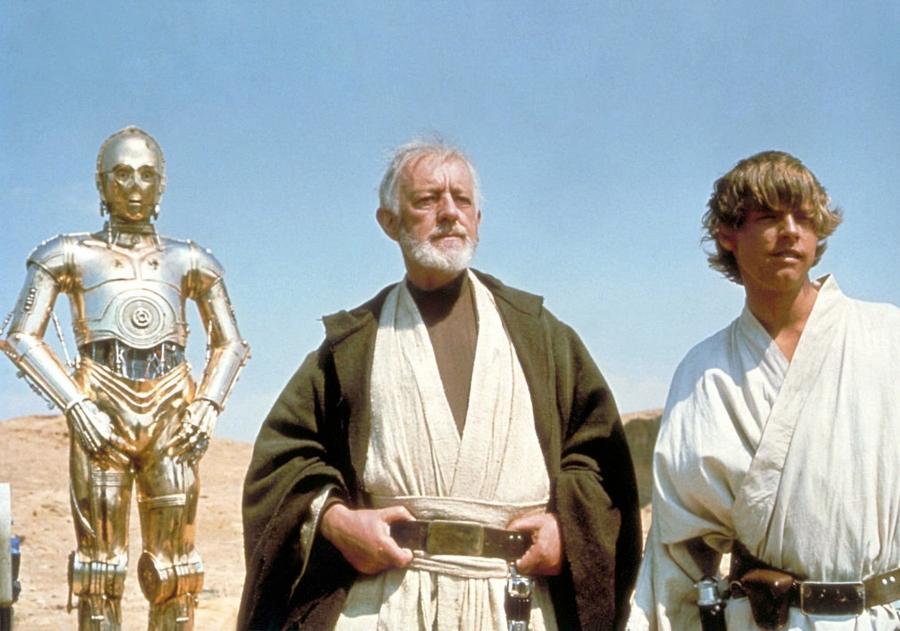
Anthony Daniels, Alec Guinness and Mark Hamill. (through Getty)
The Field Workplace Explosion
On Could 25, 1977, “Star Wars” opened in simply 32 theaters. Inside weeks, it was a runaway sensation. Traces wrapped round blocks. Audiences got here again many times. The movie grossed over $300 million in its preliminary launch, making it the highest-grossing film of all time as much as that time.
Guinness’s response was captured in his diary. On Could 27, he wrote:
“Splendid information of response to Star Wars continues to come back in.”
Per week later, he confessed:
“Am pinning my hopes on Star Wars share which may convey me £100,000 or extra if it does Jaws enterprise, as predicted.”
In actual fact, “Star Wars” did not simply match “Jaws.” It eclipsed it. Guinness’s 2.25% stake translated into greater than $7 million from the primary run alone — roughly $33 million in at this time’s cash — for lower than 20 minutes of display time.
And that was solely the start.
Many years of Royalties
The genius of Alec Guinness’s deal wasn’t simply the upfront windfall from the primary “Star Wars.” His 2.25% lower utilized in perpetuity, that means each re-release, sequel, and spin-off padded his checking account with out him lifting a finger. When “The Empire Strikes Again” arrived in 1980, Guinness reluctantly agreed to reprise Obi-Wan for a single day of filming. He thought the fabric was “uninteresting rubbishy stuff,” however he felt indebted to George Lucas and agreed to look as a Power ghost. Even so, the actual cash was already secured by the effective print of his authentic contract.
Each time “Star Wars” returned to theaters, Guinness cashed one other examine. When the Particular Editions hit in 1997, he earned tens of millions. When merchandise gross sales exploded — from motion figures to lunchboxes to video video games — his factors ensured he had a lower. By the point of his demise in 2000, his lifetime “Star Wars” earnings had been estimated at roughly $100 million. And that was 1 / 4 century in the past.
Since then, the continued monetization of the franchise — from the prequels and sequels to residence video gross sales, tv licensing, and the launch of Disney+ — has solely elevated the pie. It might be solely cheap to imagine that Guinness’s authentic deal has now generated nearer to $150 million for his property.
Legacy
It is likely one of the nice ironies in movie historical past. Alec Guinness thought “Star Wars” was beneath him, a foolish B-movie which may injury his status. As a substitute, it grew to become his most iconic function and the supply of one in every of Hollywood’s all-time smartest paydays. He might have bristled at being acknowledged solely as Obi-Wan Kenobi, however his savvy contract turned a reluctant function into generational wealth.
Guinness’s deal has additionally turn out to be a case examine in Hollywood negotiations. His determination to demand factors paved the way in which for future stars like Jack Nicholson in “Batman” and Robert Downey Jr. in “Avengers: Endgame” to safe backend earnings that dwarfed their upfront salaries. What was as soon as a reluctant actor’s insurance coverage coverage is now customary follow for A-list expertise.
Ultimately, Alec Guinness’s shrewd contract ensured that whereas Obi-Wan Kenobi taught Luke Skywalker concerning the Power, the actor behind him left the galaxy with one thing equally highly effective: one of many best monetary legacies in film historical past.
Darth Vader Makes a Enormous Mistake
Whereas Alec Guinness struck gold along with his 2% of the gross, James Earl Jones — the unmistakable voice of Darth Vader — made the alternative determination. When George Lucas first approached him in 1977, Jones was supplied factors in lieu of wage.
Jones was lifeless broke on the time and, like everybody else concerned at that time, was extraordinarily skeptical of this foolish area film. So, in what is likely to be one of the crucial regrettable choices in movie historical past, he rejected the factors supply and demanded to be paid in money… upfront. His full wage for the primary Star Wars film ended up being a grand complete of $7,000. That is equal to roughly $33,000 at this time after adjusting for inflation. Not a nasty haul for just a few hours of labor in a recording studio. Particularly for an actor struggling to pay the hire. But when solely James Earl Jones had believed a little bit extra strongly in The Power! Many years later, Jones would clarify his thought course of on the time:
“$7,000 was huge cash for me in these days. I used to be broke and wanted the cash to pay hire and purchase groceries!“
Ouch.
In fact, Jones’s profession flourished anyway. His voice grew to become one of the crucial well-known in leisure, from Mufasa in “The Lion King” to the long-lasting “That is CNN.” However in the case of “Star Wars,” the story of James Earl Jones stands as a cautionary instance of how one determination — factors versus wage — can imply the distinction between a pleasant payday and a nine-figure fortune.
Spielberg’s Pleasant Guess
There is a third chapter to the “Star Wars” factors legend — and it belongs to Steven Spielberg. In 1977, as George Lucas was ending “Star Wars,” his pal Spielberg was in the midst of his personal sci-fi challenge, “Shut Encounters of the Third Variety.” Lucas was satisfied that “Star Wars” was going to flop, whereas Spielberg’s movie could be the larger hit. Spielberg, however, had absolute religion in Lucas’s area saga.
In a second of pleasant solidarity — and possibly superstition — the 2 administrators struck a handshake deal. Lucas offered Spielberg 2.5% of the backend profits from “Star Wars,” and in change, Lucas would get the identical lower from “Shut Encounters.” Lucas believed he was hedging his bets; Spielberg believed he was making a sensible gamble.
Historical past proved Spielberg proper. “Star Wars” grew to become a cultural phenomenon, whereas “Shut Encounters” was profitable however nowhere close to the identical stratosphere. Spielberg’s lower of “Star Wars” has presumably been much like the Guinness windfall, since they’d related fairness quantities. Lucas’s share of “Shut Encounters” by comparability was far smaller.
The Different Star Wars Paydays
- Mark Hamill (Luke Skywalker): Round $650,000 for the movie. This was his breakout function, so his wage was robust for a newcomer however not star-level.
- Carrie Fisher (Princess Leia): About $1,000 per week, totaling roughly $150,000 by the tip of filming. Like Hamill, she was comparatively unknown on the time.
- Harrison Ford (Han Solo): Simply $10,000 for your complete movie. Ford was nonetheless working as a carpenter earlier than Star Wars, and his profession exploded after its launch.
- Peter Cushing (Grand Moff Tarkin): Roughly $5,000 per week; he labored for about 4 weeks, so round $20,000 complete.
