It has been 25 years since Charles Schulz handed away, however the world he created—a round-headed boy, a mischievous beagle, and a gang of lovable misfits—has by no means been extra alive. The Peanuts gang has appeared in practically each nook of worldwide tradition: on cereal bins and sneakers, in MetLife commercials and Apple TV+ reveals, on backpacks in Japan and curler coasters in California. What started as a quiet, four-panel cartoon in 1950 has ballooned right into a multi-billion-dollar empire—probably the most enduring and worthwhile mental properties of all time.
Schulz earned tons of of tens of millions of {dollars} from his creation throughout his lifetime. And that was just the start. Since his dying in 2000, Schulz’s property has earned properly over $1 billion from licensing charges, merchandising royalties, syndication offers, and animated content material partnerships. In a typical 12 months, Schulz’s heirs earn greater than the mixed estates of cultural titans like John Lennon, Jimi Hendrix, and Elizabeth Taylor.
And offers maintain occurring! Right this moment, it was revealed that Sony had paid $475 million to amass a bigger share of the rights to the Peanuts franchise. Sony already had a 39% stake. After this newest deal, it can personal 80%. The remaining 20% continues to be owned by Shulz’s kids.
How did all of this occur? How did a shy cartoonist from Minnesota construct an empire from just a few scribbled kids and a canine with goals of grandeur? How has his creation continued to mint cash a quarter-century after his passing? That is the story of how Peanuts grew to become probably the most highly effective posthumous manufacturers on the planet, and the way Charles Schulz grew to become one of many richest useless celebrities of all time.
From St. Paul to the Humorous Pages
Charles Monroe Schulz was born in 1922 in Minneapolis, Minnesota. Like his future character, Charlie Brown, his father was a barber, his mom a homemaker, and his childhood was marked by quiet introspection. As a boy, Schulz was obsessive about drawing—particularly Popeye—and by highschool, he was submitting cartoons to his faculty paper and native magazines, although with little success. He skipped two grades in elementary faculty, which left him youthful and socially remoted amongst his classmates. His grades weren’t nice, however his ambitions had been clear: he wished to be a cartoonist.
After highschool, Schulz enrolled in a correspondence artwork course and shortly discovered work at a Catholic journal drawing cartoons of a household with quirky pets. However his plans had been interrupted when he was drafted into World Struggle II. He served in Europe with the twentieth Armored Division, finally attaining the rank of employees sergeant. After the conflict, he returned to Minnesota and resumed his dream of cartooning, choosing up freelance work whereas creating an idea of his personal.
In 1949, Schulz started publishing a strip known as Li’l People within the St. Paul Pioneer Press. A 12 months later, United Function Syndicate provided to syndicate his work nationally, however the deal got here with harsh normal phrases of the period: Schulz needed to signal over 100% of the rights to the syndicate. He can be an worker, not an proprietor. Additionally they had one non-negotiable situation: the identify needed to change. Executives feared Li’l People was too near an current copyright, in order that they renamed it Peanuts (after the youngsters’s gallery on the Howdy Doody present). Schulz loathed the substitute title, calling it “completely ridiculous” and undignified, however as a result of he did not personal the IP, he had no selection however to simply accept the deal.
Early Royalties
The very first “Peanuts” cartoon was revealed on October 2, 1950, a month after Charles turned 28 years outdated. In its first 12 months of syndication, simply seven nationwide papers agreed to run the cartoon. Sigh. The subsequent 12 months, syndication picked up a bit, and Schulz managed to earn $90 per week in royalties, which is the same as round $1,200 per week in right now’s {dollars} ($62,000 per 12 months). By 1953, Peanuts was successful throughout the nation, and Charles was making $30,000 per 12 months, equal to $360,000 right now.
A Billion Greenback Cartoon
Inside just a few a long time, the strip was syndicated in over 2,600 newspapers, translated into 21 languages, and browse day by day by tons of of tens of millions. However the actual fortune got here from licensing.
Peanuts grew to become a merchandising juggernaut. Schulz licensed his characters to Hallmark, Mattel, and infinite shopper items. Snoopy appeared in Macy’s parades, on lunchboxes, wristwatches, and pajamas. By the Nineteen Eighties, Schulz was incomes an estimated $30 million a 12 months—roughly $95 million right now. From 1990 till his dying in 2000, he pulled in $40 million yearly, equal to about $80 million per 12 months in 2025 {dollars}. On the time, that made him the highest-paid entertainer on the planet.
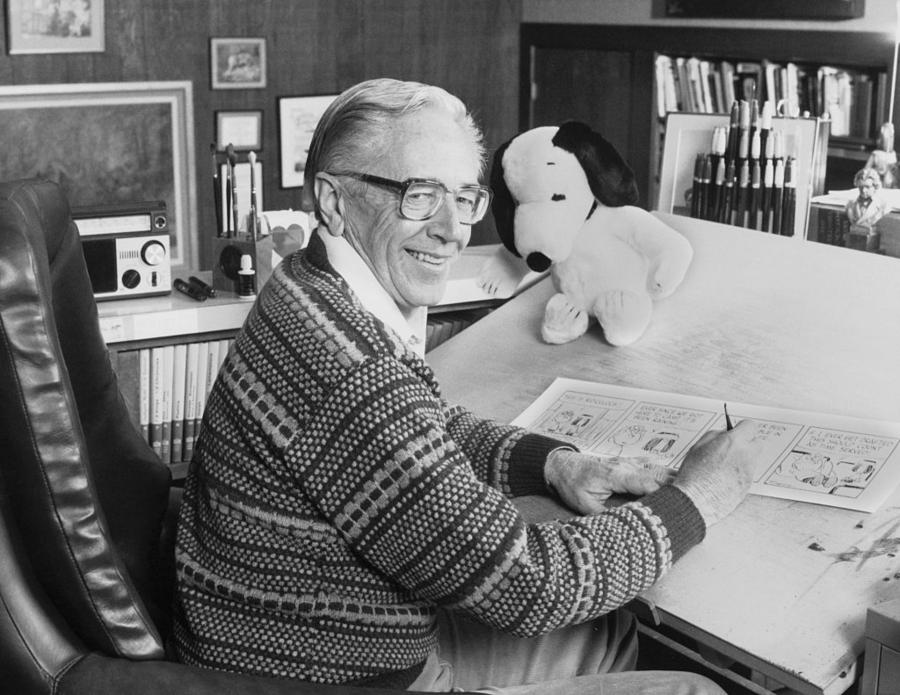
Maybe most impressively, Schulz wrote and drew each single Peanuts strip himself—17,897 in complete—proper as much as the tip.
When he died of colon most cancers on February 12, 2000, on the age of 77, the ultimate strip ran in newspapers the very subsequent day.
In his will, Schulz insisted that no new Peanuts comedian strips be drawn after his dying—a uncommon act of inventive management on the earth of syndicated comics.
Throughout his lifetime, Charles earned tons of of tens of millions of {dollars} from his superb creation. On the time of his dying, Charles Schulz’s web price was $200 million. That is the identical as round $375 million in right now’s {dollars}. However that was just the start…
(through Getty)
The Household Lastly Will get 20%
For 60 years, regardless of Charles Schulz’s immense fame and fortune, he was technically an worker. United Function Syndicate (and its mum or dad firm, E.W. Scripps) owned the Peanuts copyright, emblems, and licensing rights completely. The Schulz household obtained fats royalty checks, however they did not maintain the keys to the dominion.
That modified in 2010. E.W. Scripps, trying to exit the licensing enterprise, put the Peanuts model up on the market. The Schulz household confronted a terrifying chance: their father’s legacy might be offered to a company entity that may not respect his imaginative and prescient.
So, the household made a daring transfer. They partnered with Iconix Model Group (a licensing firm that owned manufacturers like Joe Boxer and Candie’s) to purchase again the empire their father constructed. In a deal valued at $175 million, Iconix put up nearly all of the money for an 80% stake, whereas the Schulz household paid their share to amass the remaining 20%.
It was a transformative second. For the primary time since 1950, the Schulz household weren’t simply amassing checks—they had been house owners. That 20% fairness stake gave them a everlasting seat on the desk, securing their skill to affect the model’s future and main on to the huge offers that might observe within the coming a long time.
A Posthumous Empire
Between 2001 and 2024, Schulz’s property earned a mean of $30–40 million per 12 months. Here is a sampling of the property’s annual earnings:
- 2001–2005: $20M to $35M yearly from licensing, syndication, and basic TV specials
- 2010: A pivotal 12 months. United Function Syndicate, which had distributed Peanuts since 1950, offered the IP to a newly fashioned three way partnership known as Peanuts Worldwide LLC. The client was a partnership between Iconix Model Group, which acquired an 80% stake for $175 million, and the Schulz household, which retained 20% possession, ongoing royalty rights, and last artistic approval over how the characters are used.
- 2015: The Peanuts Film grosses $246M worldwide, sparking a income surge to $40M+
- 2016: Schulz’s property hits an all-time excessive with $48M in earnings
- 2020–2024: Due to new Apple TV+ collection and specials, the property earns between $30M and $40M yearly
All instructed, Peanuts has generated over $1 billion after Charles’ dying. Not all of that goes to Charles’ heirs, although…
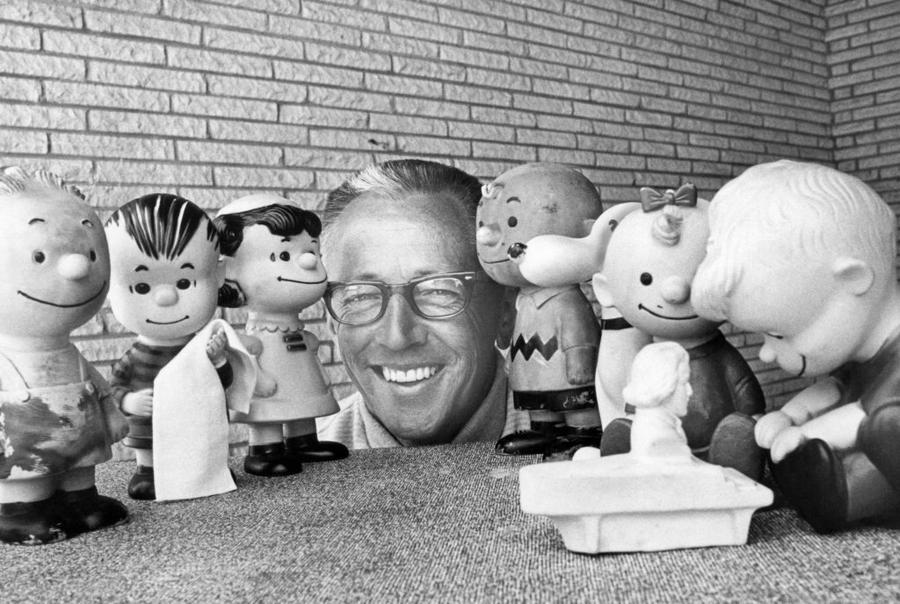
Schulz in 1966 (Picture by Underwood Archives/Getty Pictures)
Who Owns Peanuts Right this moment?
As we talked about earlier, in 2010, United Function Syndicate offered the Peanuts IP to Iconix Model Group, which fashioned a brand new firm known as Peanuts Worldwide LLC. Schulz’s household co-invested within the deal to lastly achieve a 20% possession stake in Peanuts. In 2017, Iconix offered its 80% stake to Canadian media firm DHX Media (now known as WildBrain) for $345 million.
In 2018, Japanese large Sony Music Leisure acquired a 39% stake in Peanuts from WildBrain, leading to a three-way cut up between WildBrain (~41%), Sony (~39%), and the Schulz Household (20%).
The construction modified as soon as once more simply this week. In a deal valued at roughly $457 million, Sony (through Sony Music Leisure Japan and Sony Photos Leisure) simply acquired WildBrain’s remaining stake, taking majority management of the franchise. This deal consolidated the possession construction to:
- Sony: 80%
- Schulz Household: 20%
The Schulz household, through their firm Charles M. Schulz Artistic Associates, will proceed to learn enormously as 20% house owners of the franchise. Additionally they maintain veto energy on sure artistic choices and earn royalties by means of each possession and licensing agreements. Schulz’s son Craig has been closely concerned in latest Peanuts productions and enterprise choices.
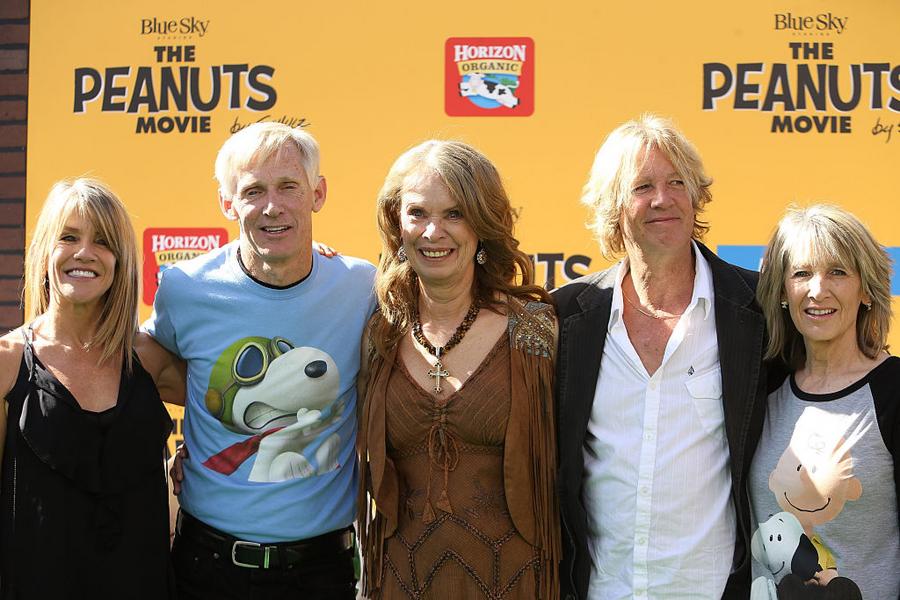
Charles’ 5 kids made a pink carpet look on the 2015 premiere of “The Peanuts Film.” From left to proper within the photograph under are: Jill, Craig Schulz, Meredith, Monte, and Amy Schulz.
(Picture by Michael Tran/FilmMagic)
Nonetheless Drawing Dividends
1 / 4-century after his passing, Charles Schulz’s empire is not simply surviving—it is making ready for an enormous enlargement. Whereas new Peanuts reveals already stream to tens of millions of Apple TV+ subscribers and merchandise traces cabinets from Tokyo to Goal, the 2025 Sony acquisition alerts a shift into overdrive.
With Sony now controlling 80% of the empire, the “quiet” cartoon is poised to change into a multimedia titan on par with Marvel or Nintendo. Sony executives have already signaled plans to leverage their large world community—spanning movie, music, and gaming—to raise the model to new heights. Trade insiders anticipate a ramp-up in function movies from Sony Photos, potential high-budget animated collection, and maybe even deeper integration into the world of video video games and anime, given the model’s large reputation in Japan. With a brand new function movie already in manufacturing and the Apple TV+ partnership secured by means of 2030, Snoopy’s calendar is fuller than it was when Schulz was nonetheless alive.
It is simple to admire Schulz for his inventive self-discipline—for writing and drawing practically 18,000 strips by hand, and for refusing to let anybody proceed the strip after his dying. But it surely’s simply as exceptional to acknowledge the enterprise engine now driving that legacy. The “no ghost artist” rule ensured the unique work remained sacred, whereas the aggressive property administration has ensured the model stays ubiquitous.
So whereas Charlie Brown could by no means win a baseball sport, and Lucy could by no means let him kick that soccer, Schulz’s legacy is something however a downer. In reality, it is a blockhead-level blowout—a multi-billion-dollar reminder that even within the afterlife, Snoopy nonetheless sleeps on prime of the doghouse, Woodstock nonetheless chirps with pleasure, and Charles Schulz nonetheless earns sufficient to maintain the kite caught firmly within the cash tree.
